As of early September 2026, the northern hemisphere is tipping into autumn. Sunrise is creeping later, sunset earlier, and for a lot of us, energy, mood and sleep will start sliding before the snow ever falls. Here’s what’s actually happening inside your body, the common winter ailments that come with it, and how a small pair of light therapy glasses called the retimer 3 is one of the simplest tools to push back.
What’s Happening to Your Body Clock Right Now
Every cell in your body runs on a roughly 24-hour schedule controlled by a tiny region in your brain called the suprachiasmatic nucleus (SCN). It is the master clock, and it is calibrated by one input above all others: light reaching your eyes.
When the days shorten, two things shift at the same time:
- Your melatonin signal stretches. In winter, melatonin tends to start earlier and run longer, which is why you feel drowsy at 4 p.m. and wide awake at midnight. A 2019 study by Danilenko et al. found that the human circadian system is phase-delayed by about half an hour in winter compared to summer (Danilenko et al., 2019, ScienceDirect).
- Your morning light dose plummets. A 2018 paper by Lowden et al. showed delayed sleep in winter is directly related to reduced natural daylight exposure, which lengthens melatonin duration and pushes the body clock later (Lowden et al., 2018, PMC).
Put the two together and you get the classic winter pattern: hard to wake up, hard to fall asleep at a reasonable hour, groggy afternoons, and a flat mood that lifts again in spring. This is not laziness. This is biology.
The Four Most Common Winter Ailments
1. The winter blues (subsyndromal SAD)
This is the largest group. About 14% of adults in the U.S. report a noticeable dip in mood and energy during the darker months without meeting the full criteria for clinical depression (Rush University overview, 2023; Mental Health America). In the U.K. and Canada, the figure rises to roughly 15–20% of the population (PMC review, NCBI).
Symptoms are familiar: lower motivation, heavier sleep, carb cravings, less patience, and the vague sense that life is ‘in greyscale’ until March.
2. Seasonal Affective Disorder (SAD)
This is the clinical version. About 5% of U.S. adults experience full SAD each year, with rates climbing as you move north — up to 9% or higher in northern latitudes (American Psychiatric Association poll, 2023; NIMH). Alaska stands out with SAD rates around 8.9% and subsyndromal winter-pattern rates above 24%, with some studies reporting nearly 44% (sciencedirect global prevalence review, 2025).
Symptoms include the above plus: persistent low mood, loss of interest, weight or appetite changes, social withdrawal, and difficulty functioning at work or home.
3. Delayed sleep phase and ‘winter insomnia’
Because winter light is weaker and arrives later in the morning, your clock drifts later. You start struggling to fall asleep before midnight, then can’t wake up before 8 or 9. This is sometimes called Delayed Sleep-Wake Phase Disorder (DSWPD), and the Cleveland Clinic notes it is essentially a chronic mismatch between your internal clock and your required schedule (Cleveland Clinic).
4. Daytime fatigue, brain fog and the 3 p.m. wall
Even when you technically sleep enough hours, the quality and timing are off. Research shows shorter winter days shift melatonin and cortisol patterns and lower pain thresholds, leaving people foggy, achy, and slow in the afternoon (orthorepair, 2025).
If any of this sounds familiar as the seasons turn, the underlying cause is almost always the same: your morning light dose has dropped below what your brain needs to anchor your clock.
How retimer 3 Helps (and what it actually is)
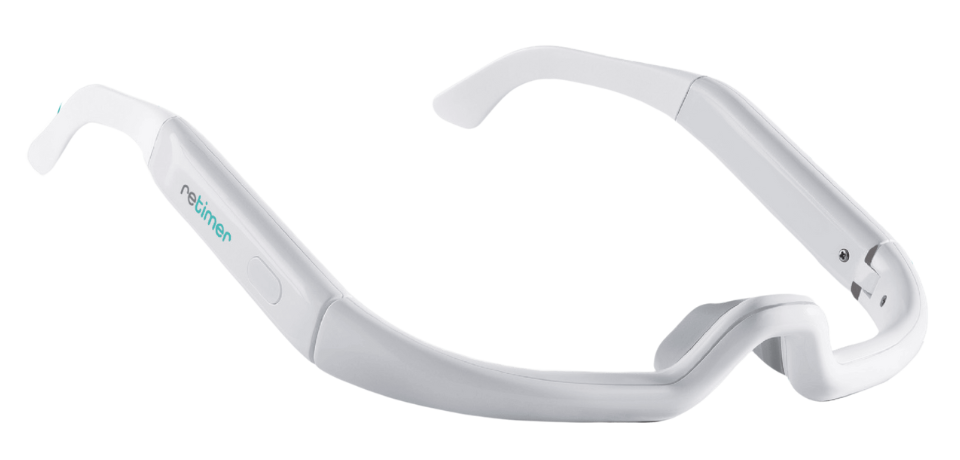
retimer 3 is a wearable light therapy device developed from over 25 years of sleep and circadian research at Flinders University in Adelaide, Australia, by clinical psychologists Professor Leon Lack and Dr Helen Wright. It looks like a slim pair of glasses and shines a precise dose of blue-green light at ~500 nm, the wavelength the brain’s circadian system is most responsive to gently into your peripheral visual field.
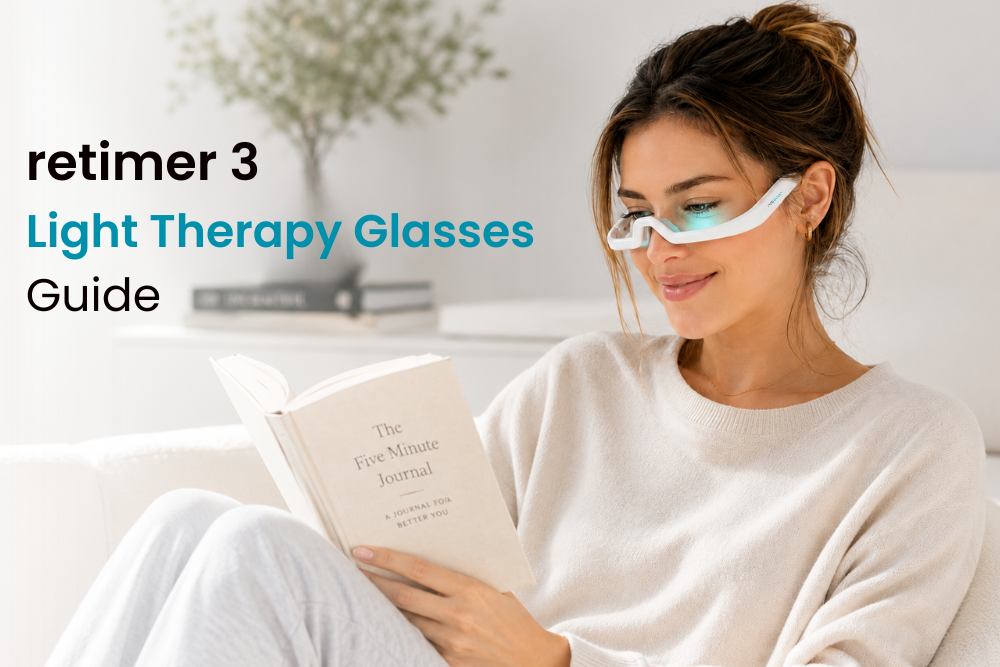
You wear it while you do other things: making coffee, answering email, and walking the dog. The light hits your eyes at the right angle, your brain registers ‘morning sun,’ and your body clock shifts accordingly.
| Specs | Detail | Source |
| Light colour | Blue-green (~500 nm) | retimer.com.au FAQ |
| LED life | 10,000+ hours | retimer.com.au FAQ |
| Weight | 36 g (1.27 oz) | retimer.com.au FAQ |
| Battery | 3.7 V, 160 mAh rechargeable Li-ion polymer, USB-C | retimer.com.au FAQ |
| Charge time | Under 2 hours | retimer.com.au FAQ |
| Battery life | Several 30–50 minute sessions per charge | retimer.com.au FAQ |
| Dimensions | 174 × 166 × 25 mm | retimer.com.au FAQ |
| App | iOS + Android; integrates with Apple Health and Health Connect | retimer.com.au |
| Warranty | 1 year | retimer.com.au FAQ |
| UV | None — visible light only | retimer.com.au FAQ |
How retimer 3 Maps to Each Winter Problem
For winter blues / SAD: Bright morning light is the most evidence-supported non-drug treatment for seasonal mood symptoms. A 10,000 lux light box used 20–30 minutes every morning typically reduces SAD symptoms within 1–2 weeks (Savant Care clinical overview; Lewy et al., JAMA Psychiatry, 1998). The retimer 3 is designed to deliver a similar morning light dose while you move around.
For Delayed Sleep-Wake Phase Disorder (winter insomnia): Morning light advances the clock, helping you feel sleepy earlier at night. Campbell’s 2017 review of bright light therapy confirms daily morning sessions are the standard approach (Campbell, 2017, PMC).
For afternoon fatigue and brain fog: A consistent morning light anchor tightens the entire 24-hour rhythm, sharpening daytime alertness and improving sleep continuity (APA on light therapy beyond depression).
For frequent flyers and shift workers: The device is portable, slim, and travel-friendly — useful for the parts of winter where your schedule is already chaotic.
Independent studies that have used retimer light therapy glasses include work at the University of Pittsburgh on adolescent sleep (Hasler et al., 2019), University of Michigan / Rush work on postpartum mood (Swanson et al., 2018), and the original Lovato & Lack 2015 trial that demonstrated phase-delaying effects of the device in healthy adults (Lovato & Lack, 2015).
Protocol: How to Actually Get the Best from It
Step 1 — Pick your season start date
In the northern hemisphere, mid-September is the right time to begin a daily routine if your symptoms have historically ramped up through October and November. Starting earlier is far easier than trying to claw back mood and sleep once SAD has set in.
Step 2 — Wear it within an hour of waking
- 20–30 minutes if you are mainly chasing mood and energy lifts.
- 30–50 minutes if you are actively trying to shift your sleep timing, recovering from jet lag, or managing DSWPD.
- Morning is the right default for most winter complaints. Lewy et al. (1998) recommended bright light immediately on awakening as the standard treatment for most SAD patients (Lewy et al., JAMA Psychiatry, 1998).
Step 3 — Wear it while you do something else
Do not sit and stare into it. The light is angled downward across your eyes — like the morning sun coming through a kitchen window. Make coffee, check email, fold laundry, scroll, and walk. The app (iOS and Android, paired with Apple Health and Health Connect) helps schedule sessions around your sleep pattern.
Step 4 — Be consistent for at least 2–3 weeks
Light therapy is not a one-shot fix. SAD symptom reductions typically appear within 1–2 weeks of consistent daily use (Savant Care clinical overview). The clock shift you build compounds — most plans need 3–7 days for the circadian rhythm to move.
Step 5 — Charge nightly and travel with the case
USB-C charging, under two hours from empty. The included travel case makes it easy to keep the routine going if you fly for the holidays, work a rotating shift, or simply head north for the ski season.
Step 6 — Combine with basic winter-sleep hygiene
- Get daylight on your face within an hour of waking, even on cloudy days.
- Dim screens 2 hours before bed; bright morning light and bright evening screens pull your clock in opposite directions.
- Keep a consistent wake time, even on weekends — your clock loves routine.
Who Should Check with A Clinician First
Light therapy is gentle for most adults, but please talk to a doctor before starting if any of the following apply:
- Bipolar disorder — bright light can occasionally trigger a manic or hypomanic episode.
- Retinal disease, macular degeneration, glaucoma, or photosensitive epilepsy — eye safety first.
- Photosensitising medications — including certain antibiotics, retinoids, and some psychiatric drugs.
- Pregnancy or postpartum mood concerns — light is generally considered low-risk but coordinate with your OB-GYN or mental-health clinician (Swanson et al., 2018).
Common Mistakes to Avoid
- Using light at the wrong time. Evening light when you want to advance the clock, or morning light when you want to delay it easy to do, and it can move you in the wrong direction.
- Stopping after one session. Circadian shifts build over days; SAD relief typically needs 1–2 weeks of consistent use.
- Expecting an instant energy jolt. Light therapy is not coffee. Sleep improves first, mood lifts next, then daytime energy follows.
- Pairing morning light with late-night phone scrolling. The blue light from screens at night undoes part of the daytime work.
- Skipping weekends. Inconsistency is the fastest way to confuse your clock.
Prepare for Winter 2026
Shorter days are not in your control; how your body responds to them is. For most adults, the simplest, safest, best-evidenced tool is the same clinicians have used for decades: a daily dose of timed bright light, ideally within an hour of waking. retimer 3 is a travel-friendly and efficient way to do that. It is backed by 25+ years of research at Flinders University and a body of independent clinical work across sleep, mood and circadian disorders.
If you’re in the northern hemisphere and the 4 p.m. sunset is starting to feel personal, you don’t have to wait until February to feel like yourself again. Wear the glasses, make breakfast, charge them at night, and let the light quietly move your clock back in your favour.
References:
- https://www.researchgate.net/publication/336572495_Summer-winter_difference_in_24 h_melatonin_rhythms_in_subjects_on_a_5-workdays_schedule_in_Siberia_without_daylight_saving_time_transitions
- https://pmc.ncbi.nlm.nih.gov/articles/PMC7509675/
- https://www.rush.edu/news/more-just-winter-blues
- https://careand.ca/blog/winter-mental-health-beyond-sad-toronto
- https://pmc.ncbi.nlm.nih.gov/articles/PMC4673349/
- https://www.psychiatry.org/patients-families/seasonal-affective-disorder
- https://www.nimh.nih.gov/health/publications/seasonal-affective-disorder
- https://www.sciencedirect.com/science/article/abs/pii/S0165032725012492
- https://my.clevelandclinic.org/health/diseases/12115-circadian-rhythm-disorders
- https://orthorepair.com/blog/how-do-shorter-days-affect-pain-and-sleep/