
The Vicious Cycle: Coffee, Melatonin, and Market Volatility
In high-frequency quantitative trading, milliseconds determine profitability. For years, I applied algorithmic precision to markets while completely ignoring the biological algorithm running my own brain. Operating out of New York, managing portfolio risk across overlapping global trading sessions, and constantly hopping time zones meant my circadian rhythm wasn’t just disrupted—it was completely broken.
My daily loop was predictable: wake up at 4:30 AM feeling like lead, down three double espressos before the London/NY cross, spend 12 hours staring at multi-monitor Bloomberg terminals, fly to London or Chicago for investor meetings, and then take 10 mg of melatonin at midnight to force my racing brain into a fitful, shallow sleep. I was using caffeine to artificially simulate morning cortisol and high-dose exogenous melatonin to knock myself out at night.
By early summer, the compound debt caught up. Brain fog crept into my trade execution, my heart rate variability (HRV) plummeted, and I was waking up multiple times every night. A consultation with a specialized Chicago-based sleep therapist provided a stark reality check:
“You don’t have an incurable insomnia problem,” she told me. “You have a profound circadian phase delay combined with light starvation during your biological morning.”
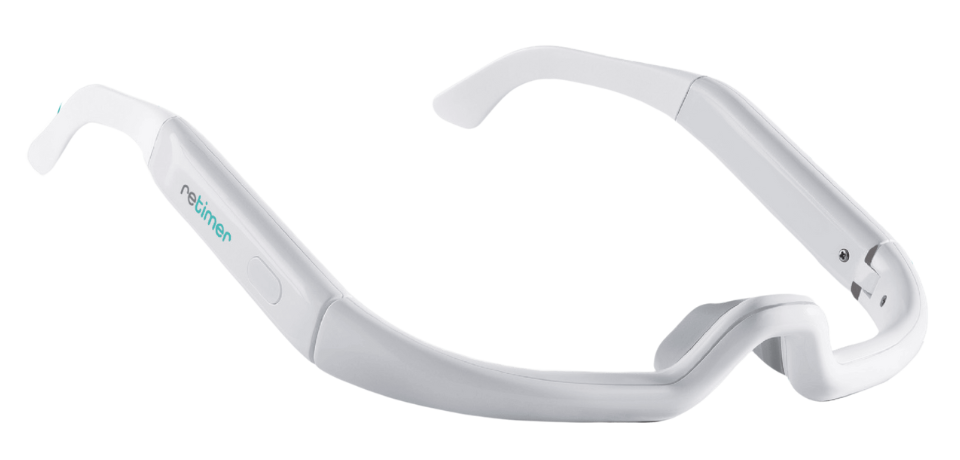
She prescribed a structural reset: ditch the 10 mg melatonin megadoses, establish clean sleep hygiene, and use targeted light therapy delivered via retimer 3 glasses every morning upon waking to entrain my central circadian clock.
Week 1: The Friction of Adaptation (Irritation & Skepticism)
When the retimer 3 package arrived, I was eager but skeptical. retimer 3 uses specialized light-emitting diodes (LEDs) located below the eyes that project a precise wavelength (blue-green light around 500 nm) directly onto the lower retina. This stimulates the intrinsically photosensitive retinal ganglion cells (ipRGCs), sending a signal via the retinohypothalamic tract to suppress melatonin production in the brain’s master clock—the suprachiasmatic nucleus (SCN).
However, putting theoretical neuroscience into practice during a high-stress trading week was far from smooth:
- Morning Eye Strain & Glare: Wearing the frame while trying to review overnight Asian market updates and early SEC filings felt awkward. The bright green-blue illumination created peripheral glare that made reading spreadsheets uncomfortable.
- Ocular Irritation & Mild Headaches: On Days 2 and 3, I experienced mild ocular fatigue and a slight frontal headache within 20 minutes of starting the 45-minute session.
- Psychological Resistance: Staring at a terminal while wearing glowing light glasses drew jokes from colleagues over video calls. I was ready to throw the device back in its box.
My therapist urged perseverance: “The retina is sensitive to neural recalibration. Reduce the intensity setting for two days, frame the light slightly lower, and do not look directly into the emitters. Give the SCN time to entrain.”
Week 2: The Turnaround and Structural Alignment
Following her advice, I modified my setup. I donned the retimer 3 at 6:00 AM while preparing my morning protein shake and pacing around my apartment—keeping my eyes off screens for the first 20 minutes. The physical irritation subsided rapidly by Day 9.
By the end of Week 2, subtle systemic shifts were emerging:
- Natural Awakening: I began waking up 5 to 10 minutes before my 6:00 AM alarm without that heavy “sleep drunkenness” (sleep inertia) that previously required immediate caffeine to clear.
- Reduced Afternoon Crash: The mid-afternoon energy trough around 2:00 PM, which used to trigger my 4th cup of coffee, softened significantly. My energy curve felt flat and steady rather than volatile.
Week 3: Circadian Entrainment and the Positive Outcome
By Week 3, the cumulative effect of daily morning photobiomodulation became undeniable. The retimer 3 had successfully anchored my biological morning. My suprachiasmatic nucleus was receiving a clear, high-lux signal at precisely the same time each day, setting off a predictable hormonal timer for the rest of the 24-hour cycle.
Key Physiological Outcomes Recorded in Week 3:
- Spontaneous Sleep Onset: Falling asleep naturally between 10:45 PM and 11:00 PM without any melatonin or sedative supplements.
- Deep Sleep Spike: Wearable tracking showed an increase in deep (slow-wave) sleep from an average of 38 minutes to 82 minutes per night.
- Complete Elimination of Melatonin: Zero exogenous melatonin required for 14 consecutive days.
- Caffeine Reduction: Tapered down from 5 cups to a single morning espresso out of preference rather than physiological survival.
Key Takeaways for Busy Professionals
As portfolio managers, we understand leverage. retimer 3 provided a high-leverage physiological intervention: 45 minutes of targeted morning light exposure unlocked a cascade of biological benefits that no pill or caffeine protocol could ever replicate.
- Push Through Week 1 Friction: Initial discomfort or mild glare is a transient adaptation phase. Don’t quit early.
- Consistency over Duration: Putting on the glasses within 15 minutes of waking at a fixed time is far more effective than erratic, longer sessions.
- Pair Light with Sleep Hygiene: Dim ambient lights in the evening, avoid screens 45 minutes before sleep, and keep bedroom temperature cool (~66°F).
Author: Senior Portfolio Manager, Quantitative Strategies