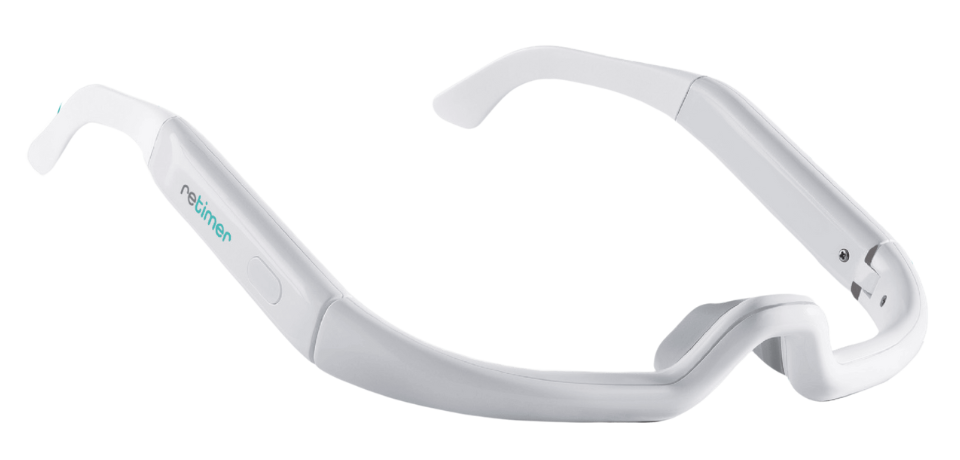

How a small pair of blue-green glasses can reset your body clock, ease jet lag, support shift workers, and help you wake up feeling like yourself again.
What the retimer 3 actually does
The retimer 3 is a wearable light therapy device that sits on your face like a pair of glasses and delivers an optimal amount of blue-green light at around 500 nanometres toward your eyes. This wavelength sits in the sweet spot that the brain uses to calibrate your body clock.
Your body has a master 24-hour clock sitting behind your eyes, called the suprachiasmatic nucleus(SCN) . It uses light signals to decide when to release sleep hormones like melatonin and when to release alertness hormones like cortisol. When that clock is misaligned with your day, you feel it: groggy mornings, foggy afternoons, restless nights.
The retimer 3 is essentially a portable “sun.” It sends bright, timed light to the part of the brain that needs it, so you can shift your rhythm forward (fall asleep earlier) or backward (stay awake later) on your own terms.
Why Many People Choose Wearable Light Over a Light Box
Earlier light therapy meant sitting still in front of a large lamp for 30 minutes, retimer 3 changes that. It is lightweight (about 36 grams / 1.27 ounces), you can wear it while doing your daily chores.
This mobility matters more than it sounds. Most light therapy plans fail because people cannot stick with a 30-minute stationary routine. A wearable removes that friction, and the consistency is what drives results.
The other reasons wearables like the retimer 3 appeal to consumers:
- You stay active during sessions. Reading, walking, working at a desk – all fine.
- Light hits your eyes from the right angle. The device is designed to deliver light downward across the eyes, mimicking morning sunlight angles.
- It travels with you. Frequent flyers and rotating shift workers can pack it in a carry-on.
A Quick Word on the Science behind retimer Light Therapy Glasses
The retimer was developed at Flinders University in Adelaide, Australia, by clinical psychologists Professor Leon Lack and Dr Helen Wright, who have been researching sleep and circadian rhythms since the late 1980s. The device itself is the result of more than 25 years of sleep research plus two years of design work with ophthalmologists.
Independent studies using retimer devices :
- Lovato & Lack (2015) - demonstrated that the retimer effectively phase-delays the circadian clock in healthy adults, supporting its use for westbound travel and late-shift schedules.
- Hasler et al. (2019, University of Pittsburgh) - showed successful sleep extension and phase advance in adolescents using 30-minute morning retimer sessions.
- Swanson et al. (2018, University of Michigan & Rush) - found home-wearable light therapy feasible and acceptable for postpartum depression.
- Zalta et al. (2019, UC / Rush / Michigan) - pilot study showed the retimer was well tolerated and perceived as beneficial by participants with probable PTSD.
- Rosa et al. (2018, Federal University of Minas Gerais) - used the retimer to entrain the sleep-wake cycle of Brazilian Olympic swimmers before the Rio 2016 Games.
- Whelan et al. (2016, University of Tasmania) - documented that pre-flight bright light therapy helped athletes maintain performance after westward time-zone changes.
Across the broader circadian research field, the mechanism is well established: timed exposure to short-wavelength visible light suppresses melatonin and shifts the timing of your dim-light melatonin onset (DLMO), the marker sleep researchers use to track the body clock (Pandi-Perumal et al., 2007, ScienceDirect; Figueiro, 2014, Nature and Science of Sleep).
What the retimer 3 Is Best Used For
The retimer 3 has been used, studied, or reviewed for several common circadian and mood complaints:
| Use case | What the light does | Typical session timing |
| Jet lag (eastward or westward) | Pushes your clock toward the destination time zone | 30-50 min, timed to direction of travel |
| Shift work | Helps your body stay alert during night shifts and sleep during the day | 30-50 min at the start of your “biological day” |
| Delayed Sleep Phase (DSPD) | Advances the clock so you fall asleep earlier | Morning sessions, typically 30-60 min |
| Advanced Sleep Phase (ASPD) | Delays the clock so you stay awake longer | Evening sessions, 30-60 min |
| Winter low mood / SAD | Replaces missing morning daylight | Morning, 20-50 min, daily during darker months |
| Sleep maintenance in older adults | Strengthens circadian amplitude | Morning sessions |
Timing Your Sessions: The Simple Protocol
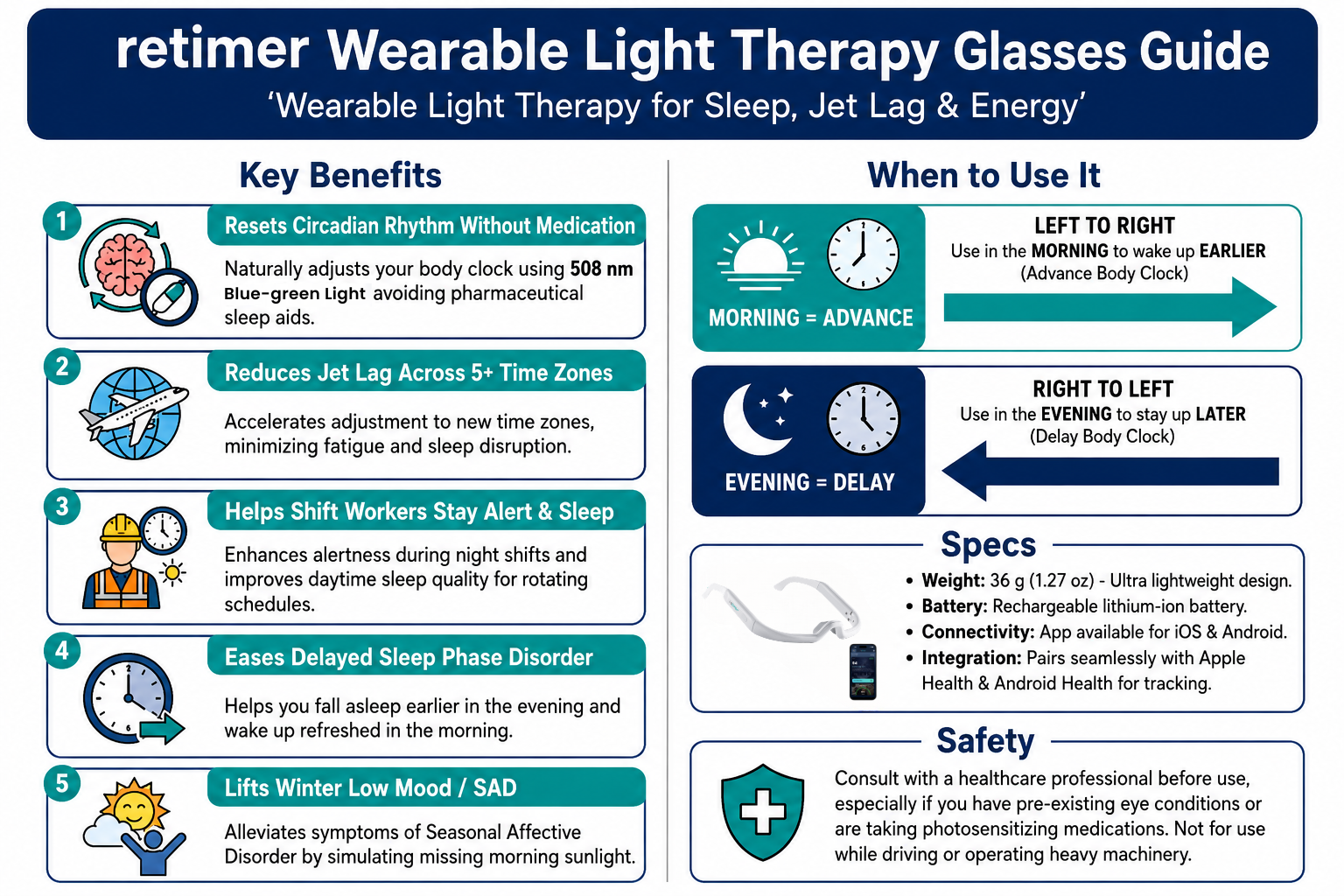
Light timing is everything. The same dose of light can move your body clock in opposite directions depending on when you use it.
Know more about your phase response curve (PRC) :
- Morning light (just after you naturally wake up) advances your clock - you will feel sleepy earlier that night. Use this for eastward jet lag, DSPD, and SAD.
- Evening light (a few hours before you want to sleep) delays your clock - you will fall asleep later. Use this for westward jet lag and ASPD.
- Light in the middle of the day has a small or mixed effect and is mostly used to boost alertness or mood.
A common starter protocol with the retimer 3:
- Jet lag eastward (e.g., New York to London): 30-50 minutes of light in the early morning of the destination, ideally starting on day one or two of your trip.
- Jet lag westward (e.g., London to Los Angeles): 30-50 minutes of light in the late afternoon/early evening of the destination.
- Shift work: 30-50 minutes at the start of your shift or just before it, to push your body into “work mode.”
- SAD / winter low mood: 20-50 minutes within an hour of waking, every day from autumn through early spring.
The retimer mobile app (available on iOS and Android, and integrated with Apple Health and Health Connect) helps you plan these sessions based on your sleep and travel schedule.
Wear, Care, and Charging Tips
Getting the most from the retimer 3 is mostly about habits:
- Charge it the night before. A full charge lasts for several sessions; plug it in on a bedside dock so it is ready at sunrise.
- Position the light correctly. The device should sit just above your eyes with the LEDs angled toward your lower eyelids. Most users read or use a phone while wearing it.
- Stay hydrated and blink normally. Staring without blinking can dry the eyes.
- Do not look directly into the LEDs. The light is meant to bathe your peripheral field, not stare at.
- Clean the device with a soft, dry microfiber cloth. Avoid solvents.
- Travel with a small hard case - the device is durable but has precision LEDs.
Five Common Mistakes to Avoid
- Using light at the wrong time of day. Evening light when you wanted to advance the clock, or morning light when you wanted to delay – this can move you in the wrong direction.
- Stopping after one session. Circadian shifts build over days. Most plans need 3-7 days of consistent use.
- Expecting instant alertness. Light therapy is not coffee. It shifts your clock gradually; you may notice sleep improvements before alertness lifts.
- Pairing light with phone scrolling at night. Blue light from screens right before bed can cancel out your daytime light efforts.
- Skipping sessions on weekends. Inconsistent timing confuses the clock. Pick a window and stick to it.
How the retimer 3 Stacks Up Against Other Light Therapy Glasses
Independent reviewers have tested the retimer 3 against Luminette 3 and AYO. A common finding: Luminette uses a blue-enriched white light at 468 nm, while the retimer uses blue-green light at around 500 nm (myluminette comparison article; Optimize Your Biology lab review). Blue-green is slightly gentler on the eyes but still highly effective at melatonin suppression. retimer 3’s design and app integration are often cited as its strengths; Luminette 3 is typically cited as the brighter, more compact alternative (goayo 2026 comparison).
Frequently Asked Questions
What is the retimer 3?
A wearable light therapy device developed from sleep research at Flinders University in Adelaide. It delivers timed blue-green light (around 500 nm) to the eyes to shift the body’s circadian clock.
How long does a session last?
Most users start with 20-30 minutes. For circadian shifting (jet lag, DSPD, shift work), 30-50 minutes per session is typical. The device is not a one-time fix; benefits build over days.
When should I use it?
Morning sessions to advance your clock (eastward travel, DSPD, SAD). Evening sessions to delay your clock (westward travel, ASPD). Use the retimer mobile app to plan timing for your specific goal.
Is it safe for daily use?
Yes for most adults. The light is visible blue-green, not UV. People with bipolar disorder, retinal disease, or photosensitivity should consult a clinician first.
Does it work for jet lag?
It is one of the most evidence-supported tools for jet lag, particularly for trips across 5 or more time zones. Direction and timing of light matter more than duration.
Can I wear it over my prescription glasses?
Yes – the retimer 3 is designed to be worn alongside regular glasses.
How long does the battery last?
A full charge supports multiple daily sessions of 30-50 minutes. Charging via the integrated rechargeable lithium cell typically takes under two hours.
Is there a companion app?
Yes. The retimer mobile app is available on iOS and Android and integrates with Apple Health and Android Health, helping you schedule sessions based on your sleep and travel plans.
The retimer 3 is not a gadget – it is a clinically grounded circadian tool. When used consistently, at the right time of day, it is one of the simplest ways to reset your body clock for travel, shift work, or darker months. Wear it while you make breakfast, charge it while you sleep, and let the light do the rest.