
“How did you sleep last night?” This is a common question asked by family members, friends or work colleagues. What would you call a ‘good’ sleep? Most likely you would say you slept well if you fell asleep quickly and didn’t wake at all during the night. A very common misconception is that good sleep is one long deep valley of unconsciousness until the morning when you awake. Our own research found that almost everybody, when asked to draw a picture of the typical sleep of a good healthy young adult, drew a long deep curve with hours of uninterrupted deep sleep across the middle part of the night. As you will see shortly this concept of normal sleep is totally incorrect.
So it is not surprising that most people would say that their sleep was ‘bad’ if they had any awakenings during the night. Even our language reflects our strongly held concept of a good sleep when we refer to sleep with an awakening during the night as ‘broken’ as if sleep were damaged by the awakening.
Yet up until only the last couple of centuries, before recent industrialisation and artificial lighting, it was common to have a long wakeful period in the middle of the night between the ‘first sleep’ and ‘second sleep’. This 1-3 hour wakeful period was often used for quiet meditation, recreation, or more productive activities. It wasn’t considered an indication of poor sleep or an impediment to the following day’s feelings or activities.
But what is a ‘good’ sleep? How often do we hear the phrase “You should get eight hours of solid sleep”? We might have heard it from our parents or doctor. We certainly hear it in the media. Therefore, it is easy to see how this relatively modern concept of ‘good’ sleep has arisen and repeatedly strengthened.
However, the technology to measure actual sleep has shown that sleep is not “solid” but more like a roller-coaster ride of several ‘ups’ and ‘downs’ across the night.

Sleep is like a roller-coaster ride not in the sense that it is an exciting event. It is like a roller coaster in that it consists of a series of valleys of deeper sleep alternating with peaks of light sleep and awakenings. The peaks are spaced about 90 minutes apart defining 90 minute sleep cycles.
Let’s take a trip on this sleep ‘roller coaster’ ride that is mapped out in the diagram.
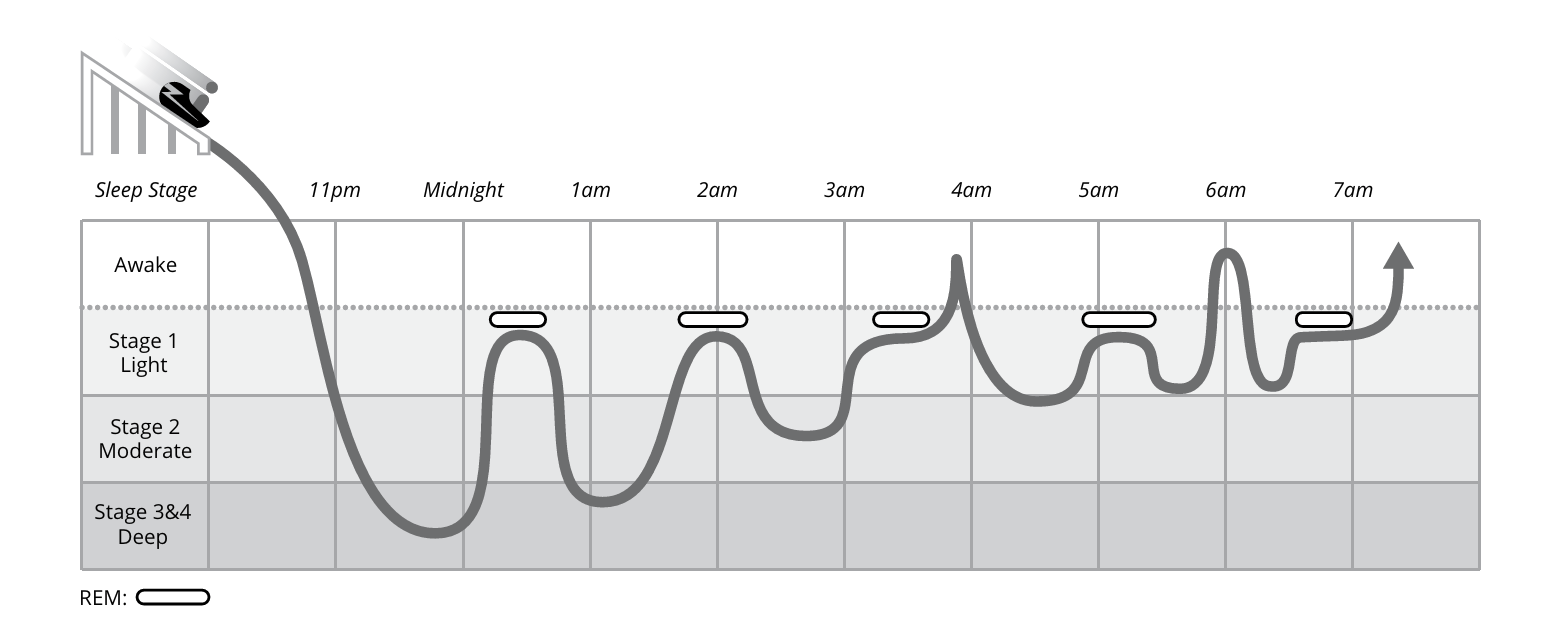
Why is sleep like a roller coaster ride? This sleep pattern is experienced by all humans, mammals, birds, and most other species. We can only speculate about this question but some have suggested the awakenings serve to “check out” the environment for any possible dangers. But aren’t we vulnerable during the deep sleep periods of the night and in danger then? Yes, but throughout most of human existence our ancestors typically slept at night in family groups. Individual bedrooms are a modern creation. In sleeping family groups, particularly those with older adults as you will see later, it would almost be automatically guaranteed that someone would be awake or in light sleep.
This would automatically provide an inbuilt sentry system to protect the family from possible dangers during the night. If this is the reason that awakenings were built into the sleep period, then we should think more kindly towards those awakenings. If our ancestors did not have them for protection, they may not have survived and we, personally, may not have existed. Think about it.
Have you ever had a night full of thinking? In the morning you recall that your mind seemed to be active a lot, although you cannot remember very much. Most people would say that was not a good night of sleep. Some would even say they didn’t sleep at all. How does this occur and does it mean you had a bad sleep?
It appears from research studies that mental activity is occurring most of the time you are asleep. When people are awoken from sleep they usually recall mental activity that had been taking place just before being awoken. It is usually only a few seconds worth of ‘thinking’. Therefore, it appears that mental activity is present almost all the time, it lasts for only a few seconds and then fades out of memory. So if you do not awake, there is no experience of this mental activity and no memory of it having occurred.
The nature of the mental activity depends on the stage of sleep and how long you have been asleep. Only in the deepest sleep stages early in the sleep period do awakenings fail to get reports of much mental activity. However, awakening out of intermediate stage 2 or lighter stage 1 sleep will almost always reveal mental activity. It may be a simple visual scene, a snippet of other sensory effect, or experience of a simple incident in your life. Awakening out of REM sleep will usually recall a more vivid, bizarre, story-like experience we call a dream.
Since awakenings across the night usually occur out of the lighter stages of sleep containing this mental activity, several brief awakenings across the night can give the impression of a night full of mental activity. This impression is heightened by the fact that sleep is a period of no memory of this mental activity. Thus you would be comparing many snippets of memories in contrast with the nothingness of sleep making it likely that the impression of wakefulness was much more prominent than your sleep. Sleep leaves no impression.
If you have a few brief awakenings across the night maybe accounting for only 15 minutes of total wake time, this is a common example of normal, satisfactory sleep. However, your estimate of the amount of wake time is likely to be much longer than 15 minutes given the contrast of the memory of this mental activity with nothing from the actual sleep time. Thus your estimate of time awake is likely to be much more than 15 minutes, perhaps 30 minutes to an hour. You have underestimated how much sleep you got. This might lead to concern or worry about your estimated 6 hours of sleep in the context of being told you should get 7-8 hours of sleep per night. If these experiences occur frequently, the worry can intensify, the awakenings become longer, and insomnia may develop.
The underestimation of sleep length is magnified by another process related to awakenings during the night. Our research has shown that awakenings from sleep are often mistaken as continuous wakefulness, not an awakening from sleep. This might be due to mistaking that sleep mental activity for being awake. In good sleepers this happens about 30% of the time, but very often (70%) in people suffering chronic insomnia. Then if a person has a couple of brief awakenings (say an hour apart), if the second awakening is not seen as an awakening out of sleep but instead as a continuation of the first awake period, they would miss that intervening sleep and underestimate their sleep by an hour.
People with chronic insomnia typically underestimate their sleep by 1-2 hours and guess their total sleep to be 4-5 hours whereas it may actually have been 6-7 hours, closer to the normal amount. The reason for this honest mis-judgement is likely to come from perceiving an awakening from sleep as simply continuous wakefulness from the previous wake period.
Now with this new information about the nature of sleep mental activity, you may be able to re-assess what is happening to you across the night.
We invite you to contact us with any questions relating to light therapy queries: [email protected]
4.42



A good night’s sleep is not necessarily a completely uninterrupted period of sleep. Normal sleep moves through different stages and cycles, including lighter sleep, deeper non-REM sleep and REM sleep. Brief awakenings can occur naturally throughout the night, and you may not remember many of them in the morning. What matters is getting enough sleep overall and waking feeling reasonably refreshed and able to function during the day.
Most adults generally need around 7 to 9 hours of sleep per night. Individual sleep needs vary, and sleep requirements also change with age. Teenagers generally need 8 to 10 hours, while younger children require more.
Yes. Brief awakenings are a normal part of human sleep. Sleep cycles move between lighter and deeper stages, and people can briefly wake several times during the night without remembering it the next morning. An occasional short awakening does not necessarily mean you have had poor-quality sleep.
Not necessarily. Many people briefly wake during normal sleep cycles. If you quickly return to sleep and feel reasonably rested the next day, occasional awakenings are not necessarily a sign that your sleep is unhealthy. However, frequent or prolonged awakenings that regularly affect daytime functioning may warrant discussion with a healthcare professional.
Sleep consists of several stages of non-REM sleep followed by REM sleep. Early in the night, deeper sleep tends to be more prominent. Later in the night, sleep becomes lighter and REM periods generally become longer. These repeating stages form sleep cycles across the night.
A sleep cycle is a progression through different stages of sleep. On average, a cycle is often described as lasting around 90 minutes, although the exact duration can vary. Several cycles occur during a typical night, with the balance of deep sleep and REM sleep changing as the night progresses.
REM stands for Rapid Eye Movement sleep. During REM sleep, brain activity becomes more active and vivid dreaming is common. REM periods generally become longer toward the end of the night, making REM an important part of the normal sleep cycle.
You can sometimes wake during a lighter stage of sleep or from REM sleep and temporarily feel surprisingly alert. This can happen as part of normal sleep physiology and does not automatically mean that you have finished sleeping for the night.
People can underestimate how much sleep they received because brief awakenings and mental activity around those awakenings may be remembered more clearly than the periods when they were asleep. This can create the impression of having been awake for much longer than you actually were.
Some mental activity can occur during sleep. When people are briefly awakened, they may remember thoughts, images or fragments of experiences that occurred immediately before waking. Remembering this activity does not necessarily mean that you were awake for the entire period.
Deep sleep is an important part of normal sleep, particularly earlier in the night. However, there is no single “perfect” amount of deep sleep that applies to everyone. Sleep needs and sleep architecture vary between people and change with age. Rather than focusing only on one sleep stage, consider your total sleep, regularity and how you function during the day.
There is nothing inherently magical about sleeping before midnight. Deep sleep tends to be concentrated in the earlier sleep cycles of your individual sleep period. Therefore, the timing of deep sleep depends partly on when you go to sleep rather than on midnight itself.
Start with consistent sleep habits. Try to maintain a regular bedtime and wake time, create a relaxing wind-down routine, keep your bedroom quiet, cool and dark, limit caffeine later in the day, and avoid bright artificial light and stimulating activities close to bedtime. Spending time outdoors during the day and staying physically active can also support healthy sleep habits.
Yes. Keeping a relatively consistent sleep and wake schedule provides regular timing cues for your body’s sleep-wake rhythm. Large differences between weekday and weekend schedules can make it harder for your body clock to maintain a consistent pattern.
Yes. Light is one of the important environmental signals that helps regulate the body’s circadian rhythm. The timing of light exposure can influence when the body naturally feels ready for sleep or wakefulness. This is why appropriately timed light therapy is used to help adjust circadian timing in some situations.
retimer is designed to use appropriately timed light exposure to influence the body’s circadian rhythm. The appropriate timing depends on the sleep schedule you are trying to change. retimer’s information explains that morning use can generally help shift sleep and wake times earlier, while evening use can shift them later.
If you regularly have difficulty falling asleep, staying asleep, waking too early, experience excessive daytime sleepiness, or find that sleep problems are affecting your daily activities, consider speaking with a healthcare professional. Persistent sleep problems can sometimes be associated with sleep or circadian-rhythm disorders.
Sleep quality
Sleep stages
Non-REM sleep
Deep sleep
REM sleep
Sleep cycles
Nighttime awakenings
Sleep duration
Sleep schedule
Circadian rhythm
Light exposure
Light therapy