Every year, hundreds of millions of people across the US, UK and Europe are told to do something their bodies fundamentally resist: lose an hour of sleep overnight and simply get on with it. On the second Sunday in March — March 8, 2026 this year in the US, and the last Sunday of March across the EU and UK, the clocks spring forward, officially beginning Daylight Saving Time (DST). It may sound like an administrative tidying of the calendar, however in biological terms, something closer to a mild dose of transatlantic jet lag, applied simultaneously to entire populations. The consequences, documented in decades of research, are far from trivial.
A Brief History of a Policy That Refuses to Die
Daylight Saving Time was introduced in Germany in 1916, ostensibly to conserve coal during wartime. The US followed the same year, the UK shortly after. Today, the practice applies to roughly 70 countries. The EU voted in 2019 to abolish the biannual switch and has yet to implement it. The US Sunshine Protection Act has passed the Senate twice and stalled in the House. In the meantime, populations are left to absorb the disruption with no systemic support.
What Happens to the Body at 2 a.m. on a Sunday?
The human body keeps time via the circadian clock, a roughly 24-hour internal rhythm governed by light exposure and regulated through melatonin and cortisol. When clocks spring forward, that clock doesn’t reset with them. The mismatch between the body’s internal time and the social clock creates a physiological state that sleep scientists describe as “social jet lag.”
A landmark 2024 study using accelerometer data from over 11,000 UK adults, published in the Journal of Sleep Research, found that mean sleep duration dropped 65 minutes on the Sunday of the spring transition compared to the Sunday before. The American Academy of Sleep Medicine’s (AASM) position statement is unambiguous: “An abundance of accumulated evidence indicates that the acute transition from standard time to daylight saving time incurs significant public health and safety risks.”
“The most acute effect would be the loss of an hour of sleep and also the inability to adapt to the new working schedule.”
Mirror UK, citing sleep scientists, March 2025
The Road Safety Crisis Nobody Talks About
The sleepier we are, the more dangerous our roads become. The numbers are striking.
A 2020 study published in Current Biology, analysing over 700,000 US car accidents from the mid-1990s to 2017, found fatal crashes increase by 6% in the week following the spring transition. In the United Kingdom, the picture is even starker: data from Scotland shows a 51% spike in road accidents during commuting hours in the days after the clock change, while eastern England records a 48% rise, according to analysis by Nexa and the RAC Foundation’s STATS19 data (2012–2017). A Spanish study published in Epidemiology found a 30% increase in fatal car accidents on the day of transition. Source
A BMJ Open study tracking 311,766 road casualties over 14 years (2005–2018) in Great Britain confirmed the pattern with clinical precision: the spring transition window around DST consistently outperforms baseline casualty rates. Source
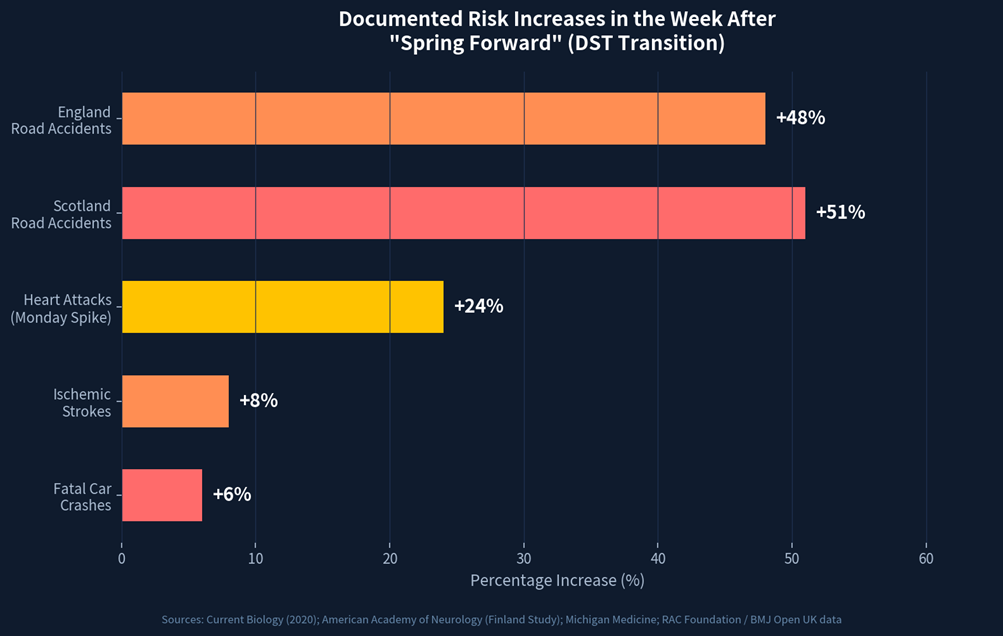
Documented Risk Increases in the Week After “Spring Forward”
The Cardiac and Neurological Toll
Road safety is only one dimension of the crisis. Cardiovascular and neurological medicine has amassed a parallel body of evidence.
Researchers at Michigan Medicine found a 24% jump in heart attacks on the Monday after the spring clock change “Heart Attack Monday,” as it has become known in cardiology circles. Source
A Finnish study, cited by the American Heart Association, found the overall rate of ischemic stroke was 8% higher in the first two days following the DST transition. Notably, the risk was even greater for cancer patients (+25%) and those over 65 (+20%). Source
The University of Bradford summarised the consensus clearly in 2024: “Every year when the clocks go forward, there is a corresponding increase in the number of heart attacks and car accidents.” Source
The Productivity Drain: Weeks, Not Days
For employers, the DST transition is a slow-burning drain on output, one that far outlasts the Monday morning grogginess most people acknowledge.
A groundbreaking 2024 study from the University of Oregon, published in the Journal of Economic Behavior & Organization, used data from GitHub developers worldwide to measure the real-world effects of DST on early-morning productivity. The finding: the adjustment to DST disrupts worker output for up to two weeks far longer than the “one tired Monday” assumption. Source
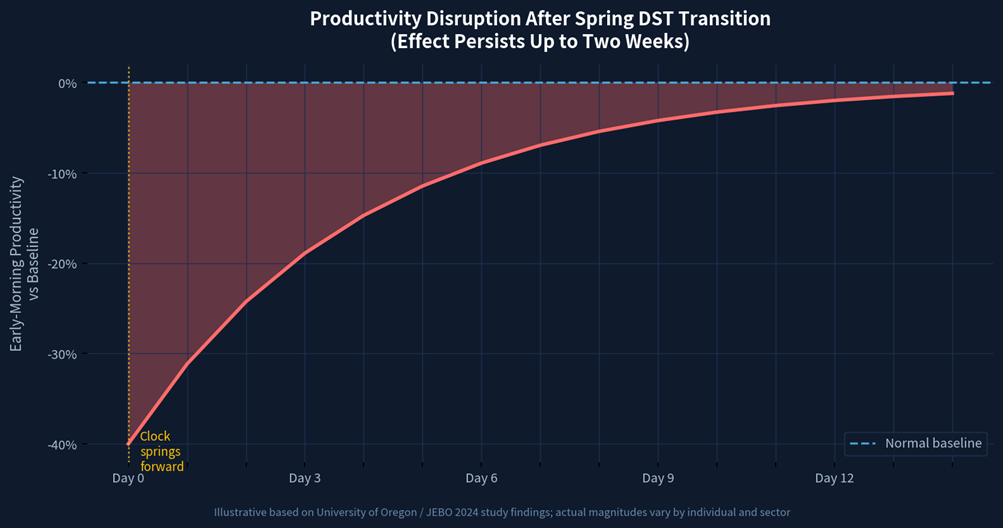
Productivity Disruption After Spring DST Transition
Workers accumulate 40 to 60 minutes of sleep debt in the week following the change and the economic meter runs accordingly.
The True Cost of Daylight Saving Time
Chmura Economics estimated the total annual U.S. economic cost of DST at $672 million in lost productivity. A broader analysis published in the Journal of Health Economics and Outcomes Research put the global figure incorporating healthcare costs alongside productivity losses tied to sleep disruption at a staggering $411 billion annually.
The Forgotten Cohorts: Shift Workers, Seniors, and Children
Not every population absorbs the shock equally. For shift workers, nurses, emergency responders, factory operatives, logistics drivers, DST collides with already-fragmented sleep schedules, compounding fatigue and increasing medical error risk. For children and adolescents, whose circadian rhythms naturally run later, the spring change means they’re being asked to function academically during what their biology considers the middle of the night.
Across continental Europe, where the clock change also takes effect on the last Sunday of March (Central European Summer Time), millions of workers and students face the same disruption from Paris to Poznań, Stockholm to Seville. Despite the EU’s 2019 vote to scrap the change, the transition remains in force as of 2026, pending unanimous agreement on which permanent time zone to adopt.
Resetting the Clock Smarter: retimer
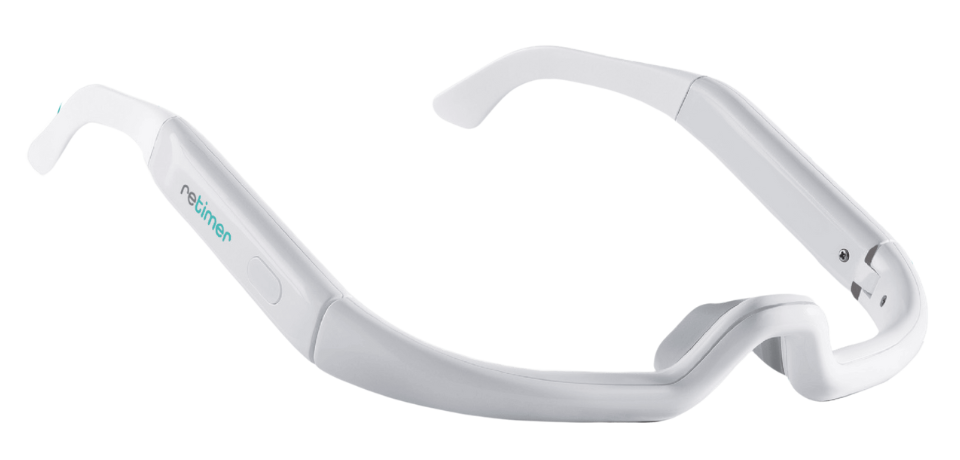
While the legislative wheels grind slowly, science offers a targeted solution: light therapy, and specifically, the clinically developed retimer wearable device.

Developed over 25 years of sleep research at Flinders University by clinical psychologists Professor Leon Lack and Dr Helen Wright world authorities on circadian biology retimer emits a precisely calibrated blue-green light that replicates the spectrum of natural sunlight most effective at resetting the circadian clock. Unlike static light boxes, the wearable glasses format means users can move freely during their morning routine while receiving the therapeutic dose of light at the optimal moment. Source
A published study on the device “Circadian phase delay using the newly developed retimer portable light device” (ResearchGate) confirmed the device’s effectiveness in phase-shifting the circadian rhythm in controlled conditions. A placebo-controlled pilot study published on PubMed Central found retimer to be “well-tolerated” with “high perceived benefit” and measurable improvements in mood and sleep symptoms. Source

Circadian Alignment
Applied specifically to the DST transition, retimer works by advancing the circadian phase in the days before the clock change, so the body’s internal clock arrives at the new schedule gradually rather than being yanked forward overnight. The retimer outlines a tailored three-to-five-day protocol : worn each morning for 30-minute sessions, the device gently coaxes the body clock forward, smoothing out the circadian mismatch before it translates into fatigue, impaired reaction times, and mood disruption.
The practical benefits documented by users and clinicians include:
- Regulated sleep onset and wake time, reducing the morning struggle that peaks in the DST transition week.
- Reduced mood disturbance and daytime sleepiness, particularly beneficial for those prone to Seasonal Affective Disorder (SAD), whose symptoms worsen with disrupted light exposure.
- Faster adaptation for shift workers, the cohort most vulnerable to compounded sleep disruption.
- Improved alertness and cognitive performance: directly relevant to the spike in road accidents and workplace errors that follows the spring clock change.
Key Sources
| Current Biology (2020) | 6% rise in fatal US car crashes post-DST |
| BMJ Open (2022) | 311,766 UK casualties over 14 years around DST |
| American Heart Association / Finland Study | 8% higher ischemic stroke rate in 2 days post-DST |
| Michigan Medicine | 24% heart attack spike on the Monday after DST |
| University of Oregon / JEBO (2024) | Productivity disruption lasts up to 2 weeks |
| Chmura Economics / MarketWatch | $672M annual U.S. economic cost |
| Flinders University / Re-Timer | 25 years of circadian research behind retimer |
| PubMed Central Pilot Study | retimer well-tolerated, high perceived benefit |
| AASM Position Statement | Public health risks of annual DST transition confirmed |