
We are living in the golden age of the “Quantified Self.” From the Silicon Valley boardroom to the fitness-conscious suburbs of Sydney and Melbourne, millions of people go to bed wearing rings, watches, and sensors that meticulously catalogue every toss, turn, and REM cycle. We wake up to “Readiness Scores” and “Sleep Efficiency” percentages, treating these numbers like a morning weather report.
But a growing frustration is emerging among the fitness and bio-hacking communities: we are data-rich, but action-poor. Knowing you had a “poor” night of sleep is merely a post-mortem; it tells you what happened, but it offers no physiological leverage to change it. To truly optimize human performance, we must move from passive monitoring to active intervention and this is where the science of light therapy, and specifically the retimer technology, transforms data from a list of complaints into a biological manual override.
The “Data Trap” and the illusion of caffeine
Most wearable users fall into the “Data Trap”—obsessively checking metrics without a mechanism to change them. When your device informs you that your circadian rhythm is out of sync manifested as a late sleep onset or morning grogginess—the traditional response is caffeine.
However, caffeine is a chemical mask. It binds to adenosine receptors to hide the feeling of sleepiness, but it does absolutely nothing to shift the underlying biological clock. In a landmark study published in Nature (2019), researchers highlighted that “social jetlag”, the gap between our internal biological clock and our social obligations—is a primary driver of metabolic distress and decreased cognitive “health span.” Simply tracking this gap doesn’t close it, to move the needle, you need a Zeitgeber (a rhythmic external cue).
Science over statistics
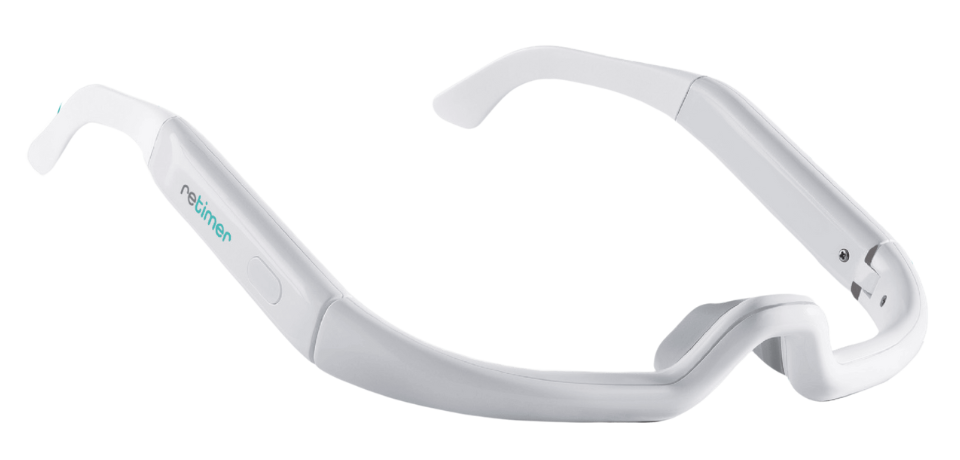
The retimer was born out of 25 years of research at Flinders University, led by Professor Leon Lack. Its value lies in its ability to act on the specific data points your wearable provides. It is the “intervention” to the wearable’s “observation”. By using the retimer at the right time, you can adjust and reset your circadian cycle to optimise performance and lifestyle.
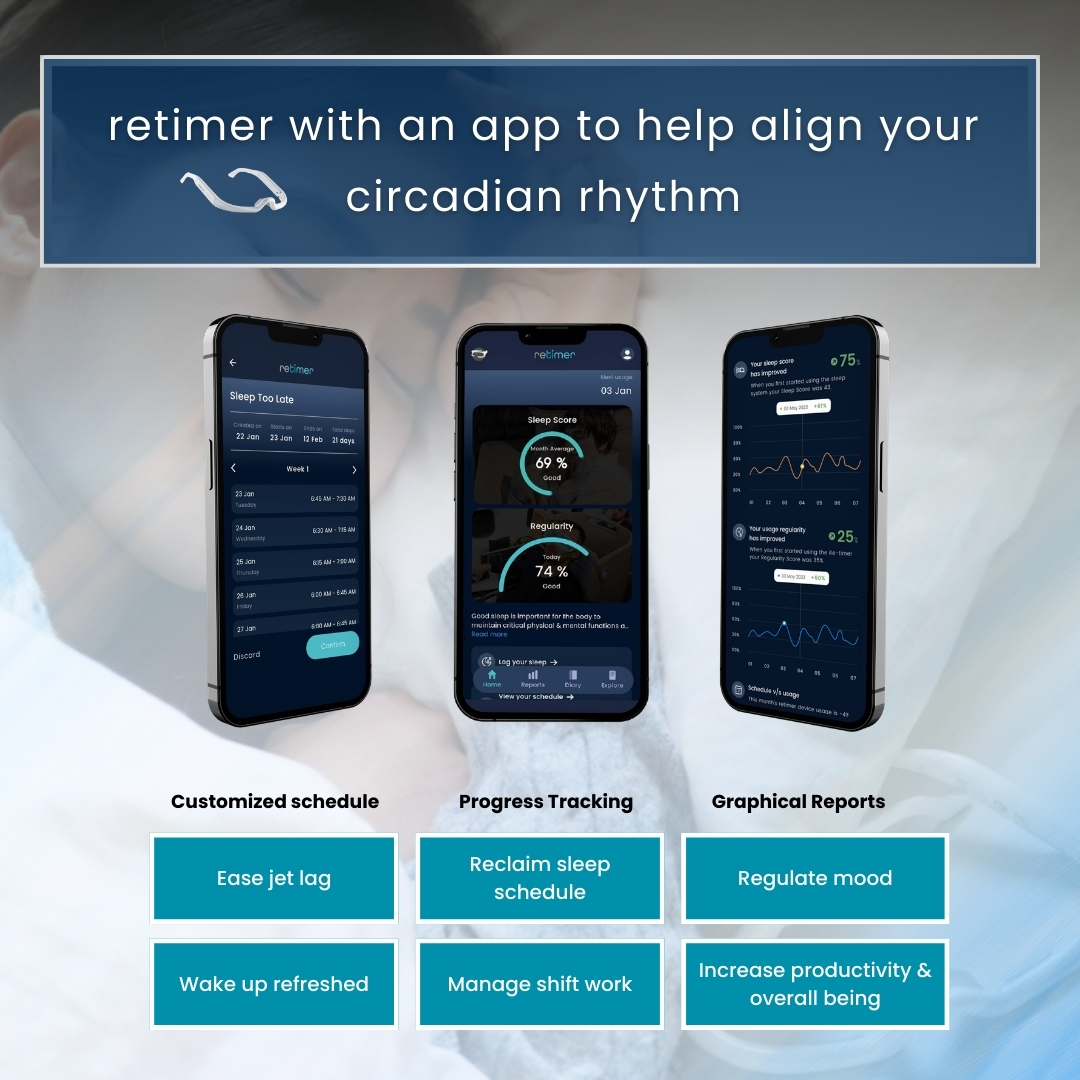
Lets look at two examples to understand how it works.
Example 1: The “Recovering Night Owl” (Phase Delay)
This is the most common issue for professionals who find themselves productive at midnight but “dead to the world” at 7:00 AM.
- The Data Insight: Your Oura or Apple Watch shows that your Resting Heart Rate (RHR) doesn’t drop to its lowest point until 6:00 AM, and your body temperature is still at its minimum when your alarm goes off. This confirms a Phase Delay: your body thinks the its still the middle of the night when its actually sunrise.
- The retimer Action: You wear the retimer for 30–60 minutes immediately upon waking.
- The Biological Shift: The 500nm blue-green light hits the photosensitive retinal ganglion cells, signaling the brain to shut down melatonin production instantly. According to research by Lack & Wright (2007) in Behavioral Sleep Medicine, this morning “pulse” of light causes a Phase Advance.
- The Result: You are manually dragging your sleep window earlier. Within days, your data will show your melatonin beginning to rise earlier in the evening, allowing you to fall asleep naturally at 11:00 PM rather than 1:00 AM.
Example 2: The “Global High-Performer” (Jet Lag)
Travel-induced jet lag is the ultimate test of circadian resilience. For an Australian flying to the US, your body is effectively operating in a different dimension than your destination.
- The Data Insight: You land in San Francisco at 9:00 AM, but your internal clock insists it is 2:00 AM in Sydney. Your wearable “Body Clock” feature shows you are in a deep physiological trough while you are trying to lead a meeting.
- The retimer Action: To sync with the new time zone, you use the retimer to provide a “false sunrise” at the destination’s optimal time.
- The Biological Shift: Humans typically adjust to new time zones at a rate of only one hour per day. By using light therapy to suppress melatonin at the correct local morning, you accelerate this process. Research in the Journal of Biological Rhythms proves that properly timed light exposure can compress a week-long adjustment period into just a couple of days.
- The Result: You bypass the “afternoon crash” and the midnight insomnia, ensuring your cognitive performance remains high regardless of the longitude.
Key takeaway
The shift from “Sleep Tracking” to “Sleep Action” represents the next frontier of wellness. Instead of waking up and being discouraged by a low sleep score, the modern performer has the option to take action and improve by using retimer.
By leveraging a university-backed, portable solution, you are no longer a victim of your genetics, work requirements or your travel schedule. In the quest for peak performance, data is just the map, retimer is the vehicle that actually gets you to your destination.